


In the rapidly evolving landscape of global agriculture—from the terraced hills of East Africa to the vast plains of Southeast Asia—mechanization is no longer a luxury; it is a necessity. However, for many farmers, the choice between a massive four-wheel tractor and a versatile Walking Tractor (Power Tiller) is a critical business decision.
At Mingsin, we believe in providing the right tool for the right field. This article explores why the walking tractor remains the most efficient, cost-effective, and versatile solution for millions of farmers today.

For a dealer or a farmer, the decision hinges on balancing power with practicality. Here is how walking tractors stack up against larger machinery.
Affordability: The initial investment for a walking tractor is significantly lower than a four-wheel model. In countries like Zambia and Malawi, where credit can be difficult to access, the lower price point allows smallholders to own their machinery rather than renting.
Fuel Efficiency: Smaller engines consume far less diesel per hectare. This is a game-changer for farmers in regions where fuel prices fluctuate.
Maneuverability in Tight Spaces: Many African farms are fragmented or located on hilly terrain. A walking tractor can turn on a dime (with a turning radius as small as 0.7m), making it ideal for small plots where a large tractor simply cannot fit.
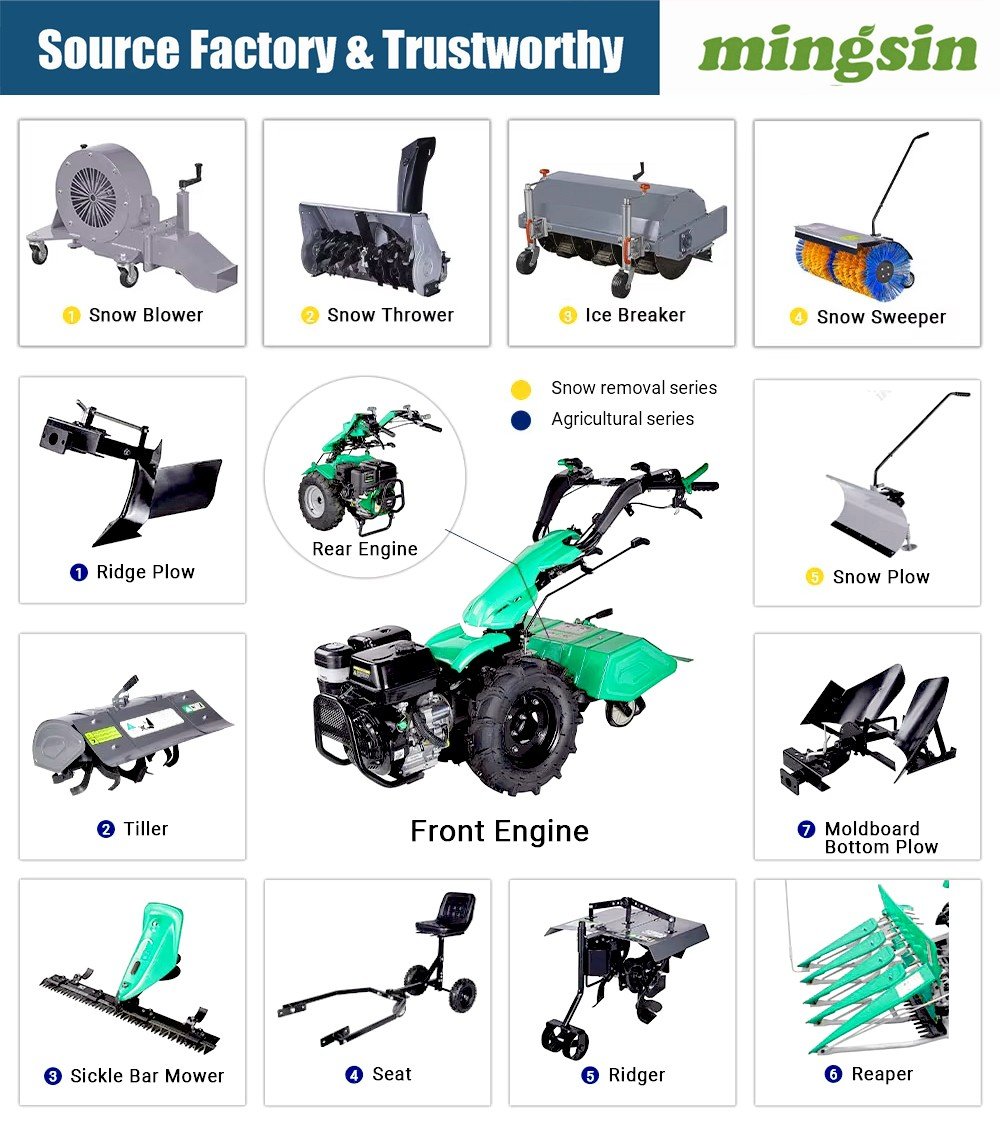
Multi-Functionality: Beyond plowing, these machines act as mobile power stations. They can pump water for irrigation, haul trailers up to 1,500kg, and even power threshers or grinders.
Soil Health: Their lighter footprint reduces soil compaction, a common problem with heavy four-wheel tractors that can damage the long-term fertility of the land.
Operator Fatigue: Operating a walk-behind unit is more physically demanding than sitting in a cab.
Mingsin Solution: Many of our models now support sulky seats (ride-on attachments) to reduce fatigue.
Lower Work Rate: For massive estates (100+ hectares), a four-wheel tractor is faster. However, for farms under 10-20 hectares, the walking tractor's efficiency is more than sufficient.

In Ghana and Nigeria, the shift from animal traction (oxen) to Mingsin walking tractors has transformed local economies.
Case Study: A farmer in Western Kenya reported that switching from manual tilling to a Mingsin MX101 reduced land preparation time from 10 days to 1 day, allowing him to plant earlier and catch the first rains, which increased his yield by 30%.
Infrastructure: In remote areas where roads are narrow and workshops are rare, the simple mechanical design of the walking tractor means local mechanics can easily maintain them using standard tools.
Not all land is the same. Mingsin has engineered three distinct series to ensure peak performance in specific environments:
The MX101 Series is our most popular "all-rounder." It is specifically designed for:
Scenario: Northern drylands, orchards, and vegetable gardens.
Key Strength: Lightweight and highly stable. It excels in hard-soil traction and is the perfect entry-level machine for farmers moving away from manual labor.
The MX-Heavy Series (12HP to 20HP) is built for the demanding conditions of South China and African river basins.
Scenario: Deep-water paddy fields and heavy-duty hauling.
Key Strength: Equipped with a reinforced gearbox and higher horsepower, these models can handle the high torque required for wet-field rototilling without "bogging down" in the mud.
The GN Series is the gold standard for intensive rice cultivation.
Scenario: Flat wetland plains and multi-crop environments.
Key Strength: Known for its superb equilibrium and specialized "anti-skid" wheels, the GN series is the preferred choice for dealers who need a machine that can transition seamlessly from plowing a flooded paddy to transporting harvested crops on the road.
Feature | MX101 Series | MX121 – MX201 Series | GN121 – GN201 Series |
Primary Terrain | Dryland / Uplands | Wetland / Heavy Paddy | Rice Paddies / Multi-use |
Best Application | Orchards, vegetable plots, and hard soil tilling. | Deep mud tilling, heavy hauling, and large-scale rice farming. | Intensive rice cultivation and versatile transportation. |
Horsepower Range | 8HP – 12HP | 12HP – 22HP | 12HP – 22HP |
Key Advantage | Compact, lightweight, and extremely easy to maneuver. | High torque and reinforced frame for demanding tasks. | Superior balance and anti-skid performance in water. |
Recommended Region | Northern dry regions (e.g., North China, Sahel region in Africa). | Southern wetlands (e.g., South China, Nile Delta, SE Asia). | Traditional rice-growing plains and river basins. |
Product Link |
When pitching these products to farmers in markets like Africa or Southeast Asia, use this "Rule of Thumb":
For the Smallholder Farmer: Recommend the MX101. It is the most "budget-friendly" and replaces animal traction (oxen) perfectly for dry crops like maize or cassava.
For the Rice Specialist: Recommend the GN Series. Its specialized design prevents the tractor from sinking in soft mud, which is a common complaint with generic machinery.
For the Contractor / Transporter: Recommend the MX151 or MX201. These farmers often use the tractor for "Custom Hiring Services"—plowing for neighbors or hauling heavy goods to the market—where the extra horsepower pays for itself quickly.

For Farmers: If you own between 1 and 15 hectares and need a machine that is easy to fix, cheap to run, and capable of five different jobs, a Mingsin walking tractor is your best investment.
For Dealers: The demand for affordable mechanization is exploding. By stocking the Mingsin range, you are offering a solution that fits the actual budget and field size of the majority of the world's farmers.
Ready to mechanize? Visit our official website to view full specifications and request a quote: www.cn-tractor.com

Please fill in your information and let us get in touch with you
Copyright © 2024 QINGDAO MINGSIN TRADE CO., LTD. All Rights Reserved.
 Powered by HiCheng